
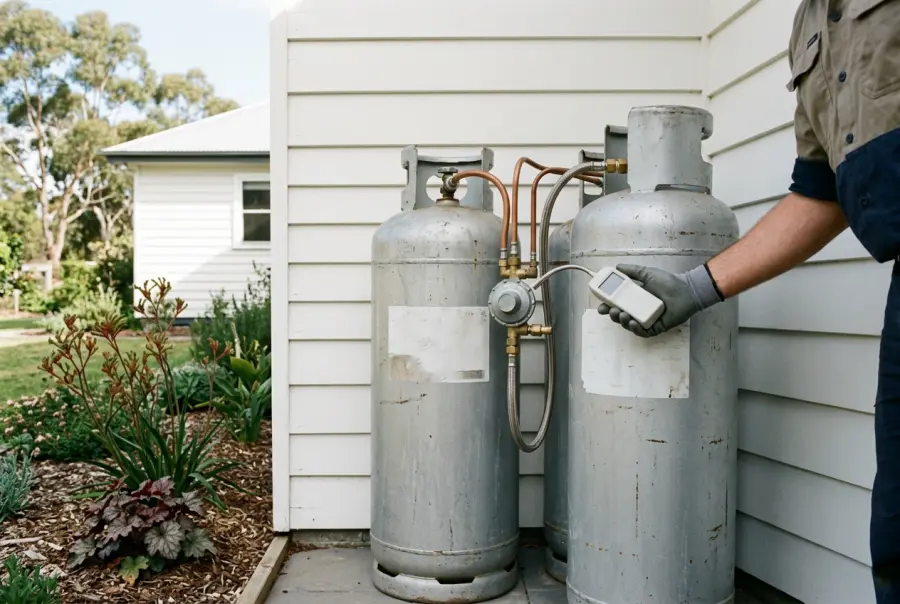
LPG bottles in the Mountains
Not every Mountains street has mains gas. Homes on the edge of town or on larger bush blocks can use LPG bottles instead. The bottles stand outside, often in pairs, with a regulator and a hose or pipe taking gas to the house.
The parts live in the weather. Frost, rain, sun and falling leaves all take a toll.
What can leak
- The valve on top of the bottle.
- The connection between the bottle and the regulator.
- The regulator itself, especially an old one.
- The hose or pigtail between bottle and fixed pipe.
- Joints on the pipe running to the house.
- Connections at appliances such as a cooktop, heater or hot water unit.
If you smell gas at the bottle
- If the smell is strong, you hear loud hissing or anyone is unwell, leave the area and call 000 first.
- If it is safe and the smell is not strong, turn the bottle valve off. Clockwise closes it.
- Keep flames and sparks well away.
- Call your LPG supplier. The number is on the bottle tag or your invoice.
- Stay out of any enclosed space with a gas smell.
Bottles are heavy and valves can be stiff. If you cannot close it, do not force it. Move away and call for help.
Who does what
The LPG supplier owns the bottles and deals with a faulty bottle or valve. They also handle exchanges. The gasfitter deals with the regulator, hoses, pipework and appliances that belong to you. If you are not sure which is which, ask when you call. If it is the supplier's part, you will be pointed back to them.
What a licensed gasfitter does
A gasfitter will usually shut the supply, check the bottle connections, regulator and hose, and test the pipework on the house side. Worn or perished parts are replaced. The system is tested again before gas is turned back on.
Signs your setup needs attention
- Cracked, stiff or faded hoses.
- A regulator that is rusty, old or hissing.
- Bottles sitting on soft ground, leaning, or buried in leaf litter and vegetation.
- A bottle cage or stand that is rusted.
- Appliances that burn weakly or yellow.
Bottle placement
Bottles should stand upright on a firm base, in the open air, clear of drains, openings and ignition sources. Bushfire-prone blocks have extra things to think about. Clear dry leaves and keep the area tidy. If you are unsure about your setup, ask a gasfitter to look at it.
Switching between LPG and mains
If mains gas has reached your street, you may wonder about changing over. A licensed gasfitter can explain what needs converting. Appliances are set up for one gas type and usually need conversion or replacement. Ask for a quote before work starts.
Related: gas leak detection and gas heater service.
Common questions
Which way do I turn an LPG bottle valve off?
Clockwise. Only do it if it is safe to reach and the smell is not strong.
Who fixes a leaking bottle valve?
Your LPG supplier owns the bottle and handles a faulty valve. Call the number on the bottle tag.
Who fixes a leaking regulator or hose?
A licensed gasfitter.
How long do regulators and hoses last?
They wear out. Check the date stamps and ask a gasfitter to look at any that are old, cracked or rusty.
Can I swap bottles myself?
Bottle exchanges are usually done by the supplier. If you handle your own, follow the supplier's instructions and ask them how to check the connections.
What does LPG leak repair cost?
It depends on what has failed. Ask for a quote before work starts.
Gas leak or gas appliance problem? Call a licensed gasfitter.